

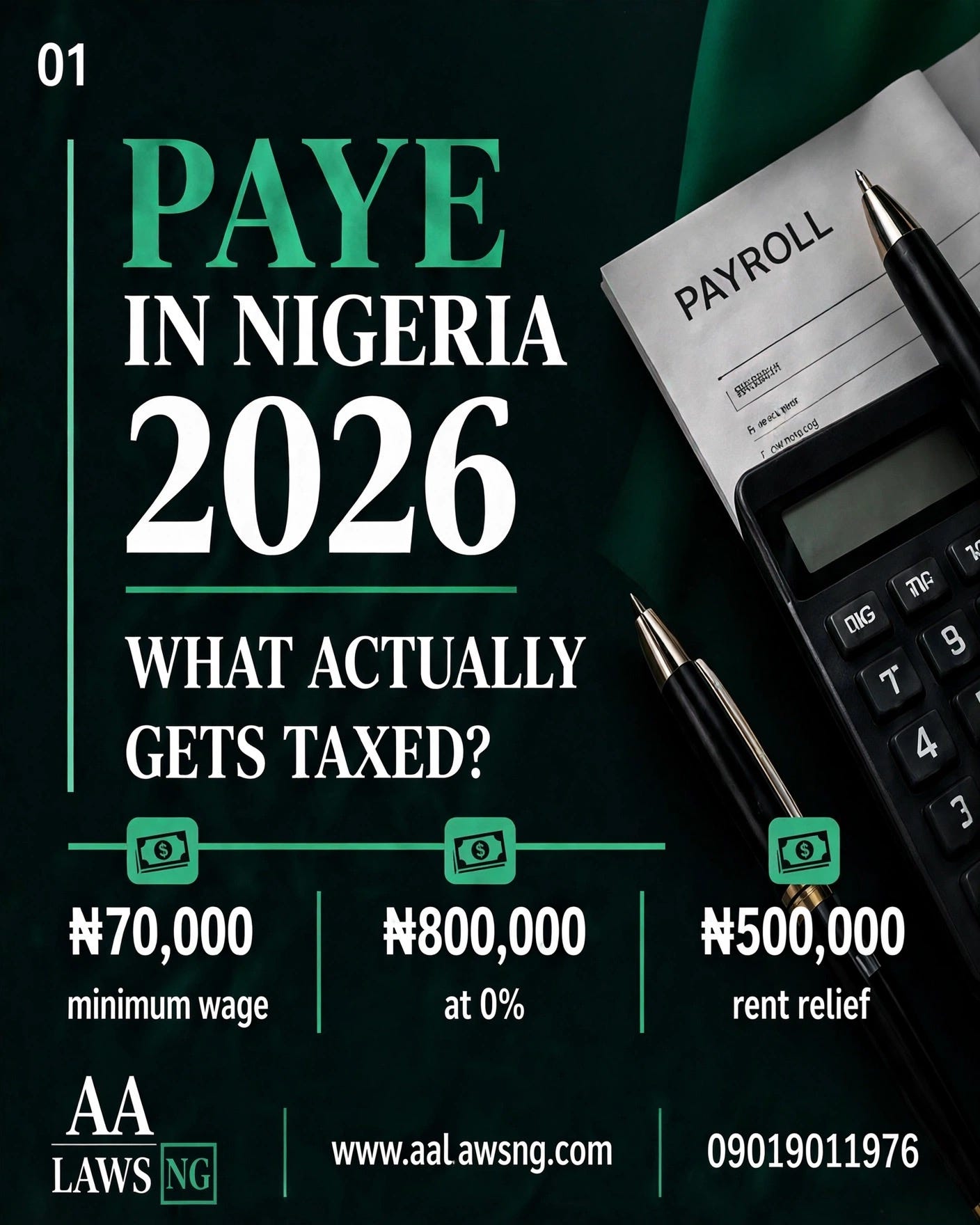
PAYE IN NIGERIA 2026: WHAT ACTUALLY GETS TAXED?
₦70,000 minimum wage. ₦800,000 at 0%. ₦500,000 rent relief.
What do these three figures actually mean for an employee’s salary?
If you employ people, run payroll, or are simply wondering why PAYE is being deducted from your salary, this is worth understanding.
One of the first things to get right is this:
Gross salary is not necessarily the same as chargeable income.
And PAYE is not simply:
Monthly salary × tax rate.
Under the Nigeria Tax Act 2025, which came into effect on 1 January 2026, individual income tax operates through a progressive rate structure after determining the individual’s chargeable income.
So, what do the figures ₦70,000, ₦800,000 and ₦500,000 actually mean?
Let’s break it down.
⸻
1. WHAT IS THE ₦70,000?
Nigeria’s National Minimum Wage was increased to ₦70,000 per month under the 2024 minimum-wage framework.
But the ₦70,000 figure also has a tax significance.
The Nigeria Tax Act 2025 expressly exempts income from employment where the person earns gross income of the National Minimum Wage or less from that employment.
So, if an employee earns:
₦70,000 per month
the annualised amount is:
₦70,000 × 12
= ₦840,000
But the fact that the annualised amount is ₦840,000 does not, by itself, mean PAYE becomes payable.
The statutory exemption applies where the employee’s gross income from that employment is at or below the National Minimum Wage.
In simple terms:
An employee earning gross income of the National Minimum Wage or less from that employment falls within the statutory employment-income exemption.
⸻
2. THEN WHAT IS THE ₦800,000?
This is a different concept.
The ₦800,000 is the first 0% tax band for chargeable income.
The Fourth Schedule to the Nigeria Tax Act 2025 provides these progressive rates:
First ₦800,000 — 0%
Next ₦2,200,000 — 15%
Next ₦9,000,000 — 18%
Next ₦13,000,000 — 21%
Next ₦25,000,000 — 23%
Above ₦50,000,000 — 25%
The important word here is:
PROGRESSIVE.
Moving into a higher band does not mean that the higher rate is suddenly applied to the entire income.
Only the portion falling within that band is taxed at that rate.
For example, where chargeable income is ₦3.1 million:
First ₦800,000 → 0%
Next ₦2.2 million → 15%
Remaining ₦100,000 → 18%
That is how the progressive system operates.
⸻
3. WHAT ACTUALLY BECOMES CHARGEABLE?
This is where the distinction between salary and chargeable income becomes important.
Under section 30 of the Nigeria Tax Act 2025, chargeable income is determined by reference to the individual’s total income under section 28, after taking into account applicable deductions, reliefs and exemptions.
Depending on the circumstances, eligible deductions include:
• Contributions under the National Housing Fund
• Contributions under the National Health Insurance Scheme
• Contributions under the Pension Reform Act
• Interest on qualifying loans for developing an owner-occupied residential house
• Qualifying life insurance or deferred annuity premiums
• Rent relief
The basic calculation is therefore:
Total income
↓
Applicable exemptions and reliefs
↓
Eligible deductions
↓
Chargeable income
↓
Apply the applicable progressive tax rates
↓
Tax liability
For an employee, the resulting employment income tax is dealt with through the PAYE system.
This is why a payroll calculation cannot be based solely on the employee’s monthly salary.
⸻
4. WHAT ABOUT THE ₦500,000 RENT RELIEF?
The ₦500,000 is the maximum rent relief.
It is not an automatic ₦500,000 deduction for every employee.
The Nigeria Tax Act 2025 provides for rent relief of:
20% of annual rent paid, subject to a maximum of ₦500,000, whichever is lower.
The individual must accurately declare the actual rent paid and provide any other relevant information required by the relevant tax authority. The Act also provides that deductions must be claimed in writing and that supporting documentary evidence may be required.
For example:
Annual rent = ₦1,000,000
20% = ₦200,000
Rent relief = ₦200,000
⸻
Annual rent = ₦2,500,000
20% = ₦500,000
Rent relief = ₦500,000
⸻
Annual rent = ₦4,000,000
20% = ₦800,000
But the statutory maximum is:
₦500,000
So the relief is not automatically ₦500,000.
It is based on 20% of the qualifying annual rent paid, subject to the statutory cap and the requirements for claiming it.
⸻
5. LET’S PUT IT INTO PRACTICE: ₦150,000 MONTHLY SALARY
Let’s take an employee earning:
₦150,000 per month
Annual salary:
₦150,000 × 12
= ₦1,800,000
For this illustration, assume:
• The employee qualifies for the full ₦500,000 rent relief; and
• We are not factoring in other eligible deductions such as qualifying pension, NHF or NHIS contributions.
Therefore:
₦1,800,000
LESS ₦500,000 rent relief
= ₦1,300,000 chargeable income
Now apply the tax bands.
First ₦800,000 @ 0%
= ₦0
Remaining:
₦1,300,000 − ₦800,000
= ₦500,000
Next ₦500,000 @ 15%
= ₦75,000
Therefore:
Annual illustrative tax = ₦75,000
Monthly equivalent:
₦75,000 ÷ 12
= ₦6,250 per month
This ₦6,250 figure is based on the assumptions in this illustration.
It should not be treated as the PAYE payable by every employee earning ₦150,000.
Other eligible deductions could reduce the chargeable income and therefore change the calculation.
⸻
6. WHAT IF THE EMPLOYEE EARNS ₦300,000?
Monthly salary:
₦300,000
Annual salary:
₦300,000 × 12
= ₦3,600,000
Assuming the full ₦500,000 rent relief:
₦3,600,000 − ₦500,000
= ₦3,100,000 chargeable income
Now apply the rates progressively.
First ₦800,000 @ 0%
= ₦0
Next ₦2,200,000 @ 15%
= ₦330,000
That brings us to:
₦800,000 + ₦2,200,000
= ₦3,000,000
Remaining:
₦3,100,000 − ₦3,000,000
= ₦100,000
Next ₦100,000 @ 18%
= ₦18,000
Therefore:
Annual illustrative tax = ₦348,000
Monthly equivalent:
₦348,000 ÷ 12
= ₦29,000 per month
Again, this is an illustration based on the stated assumptions.
⸻
7. WHAT DOES THIS MEAN FOR PAYROLL?
The examples show why PAYE calculations require more than simply applying a tax rate to gross salary.
There may be eligible deductions such as qualifying pension, NHF and NHIS contributions, as well as other deductions recognised under the Nigeria Tax Act 2025.
A practical payroll process is therefore:
Relevant income
↓
Applicable exemptions and reliefs
↓
Eligible deductions
↓
Chargeable income
↓
Progressive tax rates
↓
PAYE liability
↓
Payroll deduction and remittance
The Nigeria Tax Administration Act 2025 provides the administrative framework for PAYE, including employer obligations relating to employee emoluments and deduction of income tax from employment income.
⸻
THE TAKEAWAY
The three figures at the heart of this discussion are not interchangeable.
₦70,000 relates to the National Minimum Wage and the specific employment-income exemption.
₦800,000 is the first 0% tax band.
₦500,000 is the maximum rent relief.
They perform different functions in the tax computation.
So when calculating PAYE, start with the employee’s relevant income, consider the applicable exemptions, reliefs and eligible deductions, determine the chargeable income, and then apply the progressive tax rates.
That is the starting point for understanding 2026 PAYE.
⸻
LEGAL SOURCES
Nigeria Tax Act 2025
Nigeria Tax Administration Act 2025
National Minimum Wage Act 2019, as amended in 2024
⸻
💬 Have a legal or compliance question?
Join the AVIEL Legal & Compliance Questions Desk, open every Friday to Sunday, from 9:00 a.m. to 9:00 p.m. (WAT).
💬 https://chat.whatsapp.com/KVKn0XybBjD1I9gPEHdqYT?mode=gi_t
This publication is provided for general information and education only and does not constitute legal or professional advice. Specific advice should be obtained based on the circumstances of each business or transaction.
🌐 aalawsng.com | aasecretaries.com.ng
📞 0817 169 5516 | 0707 275 2983
AVIEL Team
The distinction between the ₦70,000 employment exemption, ₦800,000 0% band, and ₦500,000 cap is exactly where payroll errors can start, especially when a small employer treats gross monthly pay as chargeable income. The practical sequence you set out—reliefs and deductions before progressive bands—also makes a good checklist for payslip review: show the basis, deductions, taxable amount, and PAYE remitted rather than only a net figure. Clear records matter because employees and employers need to reconcile the payslip with the eventual remittance.